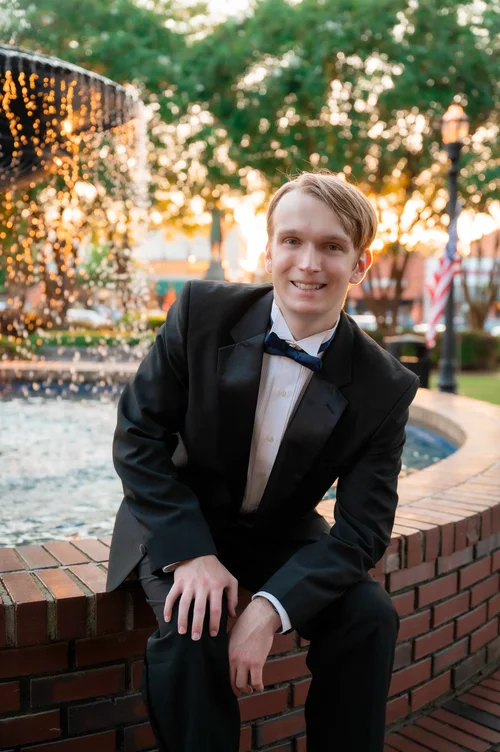
I build the systems behind the broadcast.

Today, that's a 22-PC esports arena and a corporate research studio. Next, it's the trucks and venues where live production is headed. Part-time broadcast systems engineer at IBHS, broadcast engineering coordinator for Purdue Esports, and production staff at Purdue's Hall of Music.

Parker Knabb

Parker Knabb Purdue CompE '27 · West Lafayette, IN

One from scratch. One already on air.

Two production systems I designed, built, and still support. The first was a blank slate, and I learned system design on it by trial and error. The second was a working studio with shows on the calendar, where everything had to work the first time.

Blank slate

Aug 2025–
West Lafayette, IN

Varsity esports broadcast studio

Purdue Esports

I started with a shoestring budget and no broadcast system to build on. It's an IP-based studio: vMix, OBS and Companion over OMT across segmented VLANs, with PXE boot for the lounge's 22 PCs. Most of what I know about system design I learned here, usually by getting it wrong first.

In the chain: vMix, OBS, Bitfocus Companion, OMT, RØDECaster Pro II, Blackmagic Micro Studio Camera 4K G2, Elgato Cam Link Pro, VLAN segmentation, PXE boot

System and ops documentation →
3
Person crew led on 5 weekly varsity esports broadcasts
41h
Airtime produced in a single month of the varsity esports season

Scroll sideways for the full diagram.

Video, outputs, audio and control are separate layers of one system.

Everything meets at the RØDECaster, so all audio is on one set of physical faders.

  • Caster microphones go straight into the RØDECaster Pro II over XLR.
  • Game audio rides inside the OMT streams from the observer PCs (and from the lab PC at special events), so it reaches vMix with its video. vMix sends it out on an aux bus to the RØDECaster.
  • The mix returns to vMix over USB through a virtual audio device driver, taken from the RØDECaster master bus, and vMix transmits it.
  • Casters listen on the RØDECaster's headphone outputs. The mixer's own routing sets what each of them hears.

Cameras and observer PCs in as OMT, one program out.

  • The casting cameras (Blackmagic Micro Studio 4K G2) output HDMI into an Elgato Cam Link Pro in a Thunderbolt breakout on a laptop, which sends them to vMix as OMT. The lounge PCs have no free PCIe slots, so this is the capture path.
  • Three observer PCs in the broadcast room send OMT to vMix: game or window capture when it works, full display capture when it doesn't.
  • vMix is the switcher and graphics engine. It sends program to OBS over OMT.
  • Fighting-game events add a lab PC with a second network adapter. It bridges the segmented lab and broadcast networks and pulls OMT straight from the player stations.

Where program goes after vMix.

  • Stream and recording: OBS is the only encoder. It streams program and records it. vMix does neither.
  • Multiview: a vMix fullscreen output on a GPU HDMI port drives the control-room multiview.
  • Studio monitors: a second vMix fullscreen output on a GPU HDMI port carries program to the on-site monitors.

Companion drives vMix and the mixer; the Stream Deck XL runs the show.

  • Bitfocus Companion controls vMix and the RØDECaster Pro II over MIDI.
  • Each game title is one button on the Stream Deck XL's overlay row, and the per-game overlay and routing are automated in Companion.
  • Button layouts change with context through Companion custom variables.
  • The caster table has its own Stream Deck Mini through Companion Satellite.
Pick a layer to isolate its paths.

Design notes

  1. No slot, no capture card. The lounge PCs are Alienware prebuilts with no free PCIe slots, so a capture card was never an option. Video reaches vMix over the network instead: the casting cameras through a Thunderbolt breakout on a laptop, sent as OMT. When OBS developed intermittent audio delay over OMT, I moved observer feeds to vMix Desktop Capture.
  2. One bridge between networks. The lab and broadcast networks stay segmented. For some events, one lab PC with a second network adapter acts as the video router: it pulls OMT from any of the 14 lab PCs and hands a single feed to vMix. Changing what's on stream happens at the router, instead of deep into vMix menus.
  3. Automate the repetitive. Every game title needs its own overlay and routing, so each one is a single button on the Stream Deck XL's overlay row, with the per-game routing automated in Companion. The caster table gets its own Stream Deck Mini through Companion Satellite.
  4. Mix in one place. Physical faders with all audio in one place matter more to the crew than a tidier signal path. The RØDECaster is the authoritative mixer: caster mics go straight into it, vMix sends game audio and music out on aux buses, and the mix returns on the master bus for transmission. The mixer's own routing sets what each caster hears in their headphones.
  5. Encoder separate from the switcher. OBS only encodes and records. vMix could do it all, but it sometimes needs a restart mid-show to clear an audio routing problem, and that shouldn't take the stream connection down with it. Either side can be restarted without disturbing the other.

Live system

May 2026–
Richburg, SC

Studio broadcast system

IBHS

An established studio with events already on the calendar. I built a Companion-driven control layer over its ATEM, OBS and X32 in parallel with the Studio 6 workflow, without interrupting live events. Studio 6 is now deprecated but still works as a fallback.

In the chain: Blackmagic ATEM 4K8, OBS Studio, Behringer X32 Compact, Bitfocus Companion, Stream Deck + XL, Sennheiser EW-DX, Sierra Video routing, ZoomISO, NDI

Next: A Sennheiser Spectera wideband RF system replacing Shure MXW, and a dark-fiber link that will carry 4K SDI and DAD antenna data across campus. Both in progress.

9 wk
Studio redesign to first live event at IBHS

Signal flow and design notes coming soon.

The long way here.

Purdue doesn't have a broadcast engineering program, and there's no career-fair track for this field. I found the work one show at a time, starting long before college.

A tour of The Weather Channel's broadcast facility, with a server room spanning half a floor and centralized processing at scale, made the destination clear. This is the work I want to do.

Before all of this

Self-taught since first grade.

Took apart a PC with my dad in 1st grade. Ran the computer lab before school through 5th grade. Went back to my elementary school on Tuesdays and Thursdays in 6th grade just to keep helping through "Tech on the T's." Choir from elementary school through Purdue Varsity Glee Club. FLL, FTC, and FRC robotics through senior year. A morning broadcast in middle school, edited in iMovie, played back every day. None of it was a plan.

2021–23

Johnson Ferry Baptist Church

Camera Operator & Video Director

Where I learned that live means live. I was on a Hitachi camera and Clear-Com before I had any real training, and later directed the video myself. There were no second takes, so you trusted your prep and the person calling the show. Nearly everything since has been a bigger version of a Sunday service.

2022

NCR Corporation

IT Intern

Three weeks at a Fortune 500, never on the same task twice. I noticed a repetitive internal process and built a batch script to automate it. It's been rewritten in PowerShell since, and the TechKnow Bar still runs on it. It's the least broadcast thing on this page, but it's where I learned to look for the repeated step in a workflow, which is most of what a good Companion page is.

2022

DreamHack Atlanta

Creator Hub · Livestream Technician

My first paid production gig: four days in the Creator Hub getting streamers and creators live in OBS, and by the end, acting as panel stage manager too. It was bigger than anything I'd worked, and I learned it on the floor. I came back as a Livestream Technician in May 2026. The event had grown, but the job was the same: get other people on air cleanly.

2022–23

GeorgiaFIRST Robotics

Technical Director & Producer · Peachtree Live

I was 17 when GeorgiaFIRST asked me to build a commentary show from scratch for two multi-day tournaments with 2,000+ spectators. The most useful engineering happened off camera. The event's Studio Technologies Dante intercom only reached crew at the desk, so I patched channels through Dante Virtual Soundcard into TeamSpeak and put roaming crew on comms from their own phones, at zero cost. It wasn't elegant, but it worked. I still start a system the same way: find the constraint, then the simplest fix that holds up through the show.

2023–

Purdue Hall of Music Productions

Production Staff

Most Hall of Music shifts are set and strike for university events: build it, support it, tear it down on someone else's timeline. On a handful of Purdue football and basketball games I worked camera grip/utility, supporting the operator on JVC cameras and listening on Riedel Bolero to how a director calls a game. On Purdue Grand Prix, one of the few full multicam shows HoM produces each year, I ran a camera myself in 2025 and 2026. Those shows are the closest I've been to where I'm headed.

2025

GoTo Foods

Enterprise IT Infrastructure Intern

An enterprise IT internship showed me how slowly infrastructure decisions move at scale, usually for reasons you can't see from the outside. Between network deployments and PowerShell and Python automation, I learned why change control exists and why nobody skips it. It also told me I want to be closer to live systems, where that same discipline has to happen on a show clock.

2025–

Purdue Esports

Broadcast Engineering Coordinator

I started at the Alienware Gaming Lounge in November 2024, helping the outgoing coordinator with broadcast operations, and took over the program in August 2025. I built the system with no budget and no precedent, so every call was mine, and most of the design came from working around what the lounge didn't have. Now I lead a crew of three. The documentation matters as much as the rack, because the crew runs the show when I'm not there.

The system it led to ↑

2026

LEAP (Live Events And Productions) student production club

LED Tech, EDM Show at the Purdue Armory

Three LED panel types (Firefly, Coleder, and PixelFLEX) had to work as one wall, on stage and flown, and I had never opened NovaLCT. I had six hours before doors. I got all three running by working through the NovaStar documentation one panel type at a time. Mostly it taught me to read a vendor manual fast.

2026–27

Purdue Varsity Glee Club

Audio Engineer

Three years on the risers taught me what a mix sounds like from inside it. For 2026–27 I'm behind the console on tour, making the calls I used to trust someone else was making. If anyone in the audience notices the mix, something has gone wrong.

2026–

IBHS, Richburg, SC

Broadcast Engineering Intern → Broadcast Systems Engineer (Part-time)

I built the esports system from a blank page. IBHS was the opposite: an established facility with a real budget and other people's workflows already running. First I had to make the case for changing something that worked. Then I moved switching to an ATEM and tied it together in Companion while shows kept running on the old system. The new one carried its first live event nine weeks in. These days the work is RF and fiber, with a Spectera deployment and a dark-fiber link across campus both still in progress.

The system it led to ↑

Show credits

Put me on the crew.

Two systems so far: one from scratch, one already on air. I'd like the third one to be on a truck.

Seeking broadcast engineering roles and apprenticeships starting May 2027, including mobile production / OB. Open to travel and relocation.

parker@parkerknabb.com